

Composable architecture is a way of building a web platform from independent, specialized components (content management, commerce, search, the frontend) connected through APIs, so that any single part can be replaced without rebuilding everything around it. When a tool stops serving the business, you swap that component, not the whole platform. This guide from Bejamas, a team that designs, migrates, and runs composable web platforms, explains where the model came from, when it pays off, and what it takes to operate.
For most of the web’s history, platform decisions were all-or-nothing. A monolithic suite bundled content management, templates, search, and hosting into one codebase and one contract. That bundling is exactly what makes change expensive: when one part falls behind, whether it is the editor experience, the performance, or the licensing bill, the traditional answer has been to replatform everything, a project measured in quarters or years. By the time the new build ships, the requirements have often moved again.
Composable architecture is the alternative: keep the parts that work, replace the part that doesn’t, and connect everything through APIs so that the next change is smaller than the last one.
What is composable architecture?
Composable architecture is an approach to designing and building web platforms that emphasizes modularity, flexibility, and the freedom to change one decision without reopening all the others. In web development and e-commerce it has become the standard way organizations move on from suites they have outgrown. This is what people mean by web composability.
At its core, composable architecture breaks a large, monolithic platform into specialized tools. Each is a modular system with a specific job: a content platform, a commerce engine, a search service, a frontend layer. Unlike traditional one-size-fits-all suites, a composable approach lets you select only the tools that match your actual business requirements.
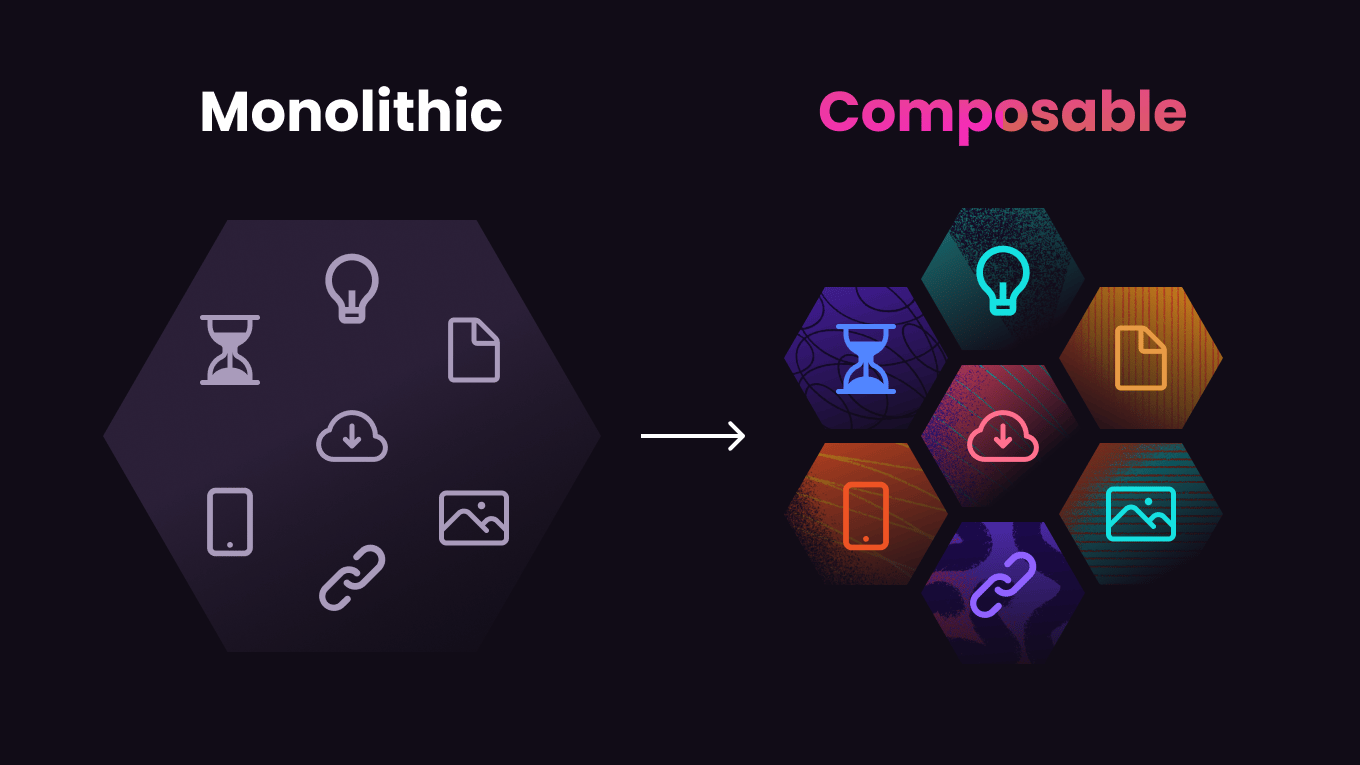
The defining feature is interchangeability. Components are designed to be swapped and combined (“composed”) in different ways as needs change. You are not locked into a single vendor’s roadmap: when a better or more cost-effective option appears for one layer, you can adopt it without touching the rest of the stack.
APIs (application programming interfaces) make this possible. They are the connectors that let independent components communicate, and they are what keep the exit door open. A component you can integrate over an API is also a component you can unplug.
For the person who owns the website budget, this translates into three practical outcomes: brands, markets, and locales can be consolidated onto one shared platform instead of a patchwork of CMSs; editors and marketers publish without waiting on developers; and the cost of change drops, because change stops meaning “replatform.”
The origins of composable architecture
Composable architecture has its roots in the concept of composable commerce, a term first coined by Gartner in June 2020. Composable commerce describes a modular approach to digital commerce built on the principles of composable architecture: a collection of best-in-breed solutions that organizations assemble into a technology stack tailored to their specific needs.
The evolution leading here ran through several stages: the adoption of software as a service (SaaS), the emergence of headless architectures, and the introduction of MACH principles. Composable commerce, as articulated by Gartner, packaged that continuum into a business framework.
Gartner’s contribution was to take the existing technical elements (the MACH stack and related technologies) and reframe them in business terms: commerce experiences constructed from modular, interchangeable components it called “packaged business capabilities.” Six years on, what began as an analyst thesis is standard practice across the digital experience platform market.
Packaged business capabilities: the building blocks of composable architecture
Packaged Business Capabilities, or PBCs, are the building blocks of composable commerce: units of functionality scoped to a business capability, ready to be pieced together into solutions tailored to your needs.
PBCs simplify complexity. Picture running an online store: handling the shopping cart, processing checkout, organizing customer data. Each of these functions can be treated as an independent microservice, and a bundle of related microservices, say the whole shopping experience, becomes one PBC.
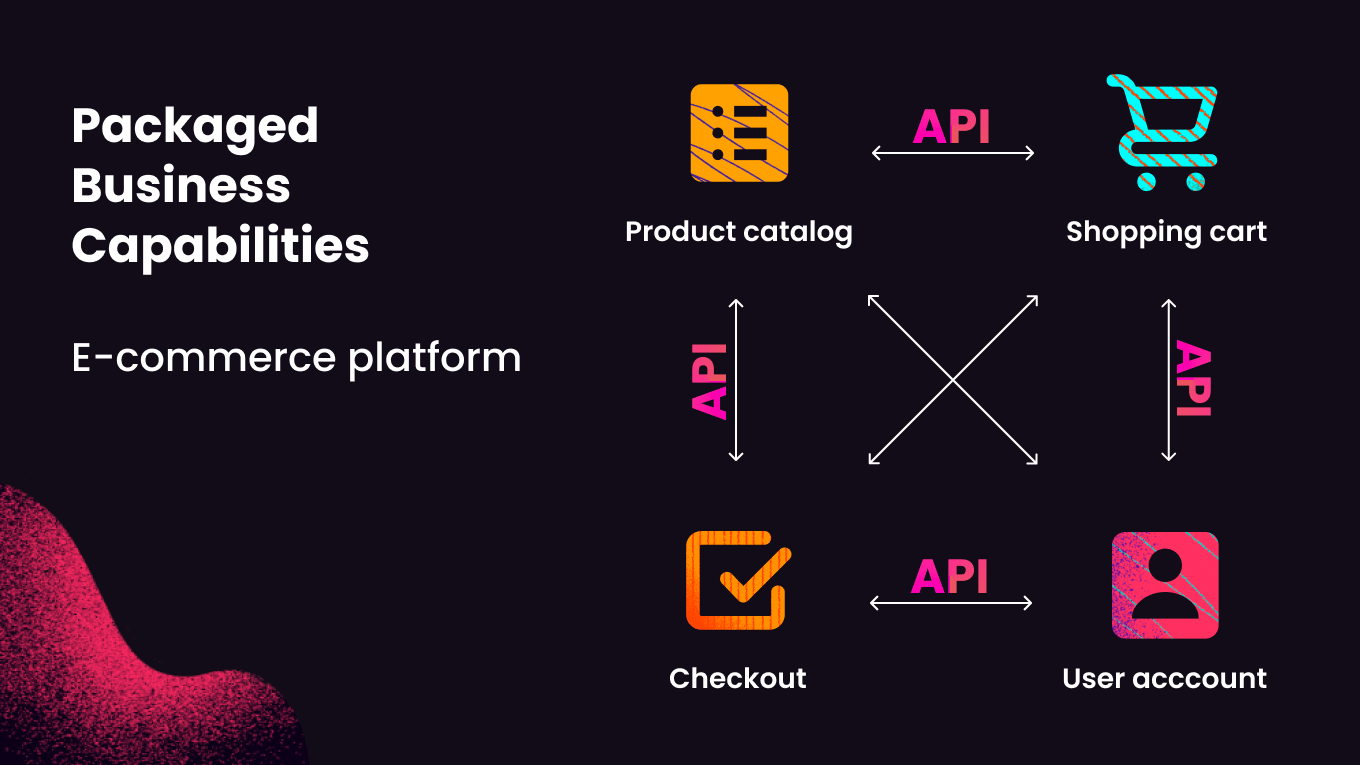
What makes PBCs useful is their independence. They operate on their own, with minimal reliance on external systems, which keeps the wider platform running smoothly and simplifies the management of interdependencies.
These building blocks communicate through APIs, ensuring fast and secure data exchange between components that were never designed as one product.
Think of PBCs as the digital equivalent of Lego bricks, pre-equipped with the functionality a business needs. You can construct complex systems from reusable components: a small set of microservices for a simple task, a larger collection for extensive operations. In software terms, a PBC is one or more microservices accessible through a single API, like a bundle combining a shopping cart and checkout.
Composable architecture puts this concept into practice: assembling autonomous, modular components (microservices, headless applications, and PBCs) into a complete, adaptable system. These capabilities are usually implemented within a modern, cloud-native architecture following the principles of MACH.
MACH architecture: enabling composability
MACH (short for Microservices, API-first, Cloud-Native, and Headless) is the technical framework that makes composability workable in practice.
Microservices are small, independent services that each focus on a specific function. They keep development and maintenance contained: a change to one service doesn’t ripple through the whole platform.
API-first: every component is built to be integrated over an API. This is what ensures smooth communication between services, and it is the property that reduces vendor lock-in.
Cloud-native components are designed to run on cloud infrastructure, scaling with demand rather than with server purchases. This is where much of the cost efficiency comes from.
Headless means the frontend presentation is separated from the backend functionality. In buyer terms: one content platform can feed every brand site, app, and channel, and marketers can publish without waiting on a developer release cycle.
MACH is no longer a niche position. The MACH Alliance, the industry body founded in 2020 to certify vendors and system integrators against these principles, now counts more than 100 member companies. Its research published in early 2026 found that organizations with fully implemented, scaled composable foundations were roughly six times more likely to report clear ROI on AI investments than those still in early planning. The API-first content and data that composability produces is the same substrate AI initiatives need.
That said, MACH is a powerful enabler of composable architecture, not the only approach. In practice, most organizations run a blend of architectures while they transition from monolithic systems, and that is fine. Composability is a direction, not a purity test.
Benefits of composable architecture
Vendor lists of benefits run long. These are the eight that hold up in practice, and what each means for the team paying for the platform.
1. Faster time to market
Monolithic systems change at the pace of their release cycle. In a composable setup, teams change one component at a time: a new campaign site, a new market, a new integration ships without a platform-wide project behind it.
2. Cost reduction
You buy only the capabilities you need, instead of licensing a suite and using a third of it. The larger, quieter saving comes at replacement time: swapping one component costs a fraction of a full replatform, and consolidating scattered CMS licenses onto one shared platform cuts recurring spend and duplicated maintenance.
3. Omnichannel experiences
Because content and commerce live behind APIs, the same source feeds your website, apps, and in-store screens. It also feeds channels that didn’t exist when the stack was chosen, including AI assistants and agents that consume structured content. API-first content is ready for surfaces you haven’t planned yet.
4. Flexibility
You build the stack around your operating model, not the other way around. Components can be customized per brand or market while sharing a common design system and component library underneath.
5. Security
A decoupled frontend exposes far less attack surface than a CMS that renders pages directly, and each specialized vendor is responsible for patching its own service. Fewer plugins bolted onto one monolith means fewer places for an attack to land.
6. Speed
Fast sites convert better and rank better. Composable frontends serve pre-rendered or cached pages from a CDN close to the visitor, which is why they consistently perform well on Core Web Vitals. Every part of the page pipeline is a component you chose for the job.
7. Scalability
Traffic spikes are absorbed by the CDN and by cloud services that scale independently. A product launch or press mention doesn’t require anyone to provision servers.
8. Increased employee retention
Senior engineers prefer working with modern, well-documented tools. Legacy stacks make hiring harder and turnover more likely; a composable stack keeps the work attractive to the people you want to keep.
Implementing composable architecture
Composable architecture pays off most for organizations whose web estate has become genuinely complex (multiple brands, markets, systems, or stakeholder groups) and for growing teams that expect to keep adding capabilities. If your website is one brand, one locale, and one steady set of requirements, a simpler setup may serve you better.
If the fit is right, here is how to approach the implementation:
Start with a clear business case
Frame the value in money and time: lower operating cost, shorter time-to-market, and the avoided cost of the next full replatform, usually the biggest line of all.
Staffing and skillset
Make sure the right skills exist in-house or with a partner. Composable systems reward teams that work with clear contracts between components and shared engineering practices.
Non-technical considerations
Understand the non-technical implications: shared responsibility across teams, legal and compliance review of each vendor, and vendor assessment on security, support, and scalability rather than features alone.
Gradual transition
The transition can and usually should be incremental: develop and test individual components before integrating them, and migrate one part of the estate at a time to minimize disruption. If the transition replaces your CMS or consolidates domains, plan the SEO controls before anything moves. Our guide to protecting organic traffic through a replatform covers the URL inventory, redirect mapping, and monitoring that make that safe, and if the new stack includes a headless CMS, what that changes for SEO is worth reading before the platform decision.
Specialized assistance
Consider engaging a partner that has run this migration before, one that understands your specific components and requirements, not just the technology in general.
Agile frameworks
Use a scalable delivery framework to govern the transition, so the architecture keeps evolving in line with the organization’s goals after the first launch.
Component identification
Identify the independent units of functionality in your current system that can become reusable components. Start from the decision, not the tool: our stack library breaks the platform down layer by layer. For the content layer, comparisons like Sanity vs. Contentful matter less as feature checklists than as fits for your editorial model.
Documentation
Document each component well. In a composable system, the decisions — why this tool, integrated this way — are as valuable as the code.
Dependency analysis
Map the dependencies and interfaces between components, with particular attention to the APIs that carry the communication.
Individual development and testing
Develop and test components individually and as part of the whole. Automated tests are what let you swap a component later with confidence.
Infrastructure automation
Manage infrastructure components independently and automate their management to reduce manual errors and operating effort.
Multicloud strategy
Where it makes sense, spread workloads across providers to reduce concentration risk and keep hosting decisions as swappable as the rest of the stack.
Rationalize your portfolio
Review the portfolio continuously. Remove components and APIs that overlap or no longer align with the business. Composability includes the discipline of subtraction.
Challenges of composable architecture
Composable architecture solves the replatforming problem, but it is not free. Go in with clear eyes about the costs.
Increased complexity
Integrating systems that weren’t originally designed to work together makes the architecture more complex. Someone has to own the whole, not just the parts.
Managing more components
More components means more contracts, more updates, and more version histories to track. This is the most common failure mode we see in 2026: stacks that grew one “best-in-class” subscription at a time until nobody could name the total cost. Composability is supposed to lower operating cost, but that only holds if someone owns the portfolio, which is why many organizations are now consolidating overgrown composable stacks down to fewer, better-chosen components.
Lack of standardization
Mixing vendors means there may be no single standard way of doing things across the system, which makes consistency and maintenance harder without deliberate conventions.
Reliability and performance
Components that weren’t built together can produce reliability and performance issues at the seams. Unlike a monolith, where the vendor irons out the interactions before release, a composable system makes you responsible for the integration quality.
Interoperability
Everything depends on the interfaces. APIs make communication possible, but keeping those integrations healthy across vendor updates takes ongoing attention.
Data consistency
Loosely coupled components can drift: the same customer or content record represented slightly differently in each system. Without a plan for where each kind of data lives, you get inconsistency and redundancy.
Feature overload
Flexibility invites accumulation. It is easy to keep adding capabilities because you can; the discipline is prioritizing what actually differentiates your platform.
Meticulous planning, well-defined interfaces between components, and a focus on core capabilities are what let you capture the advantages while keeping these risks contained.
Composable architecture, MACH, and Jamstack
Three terms cover overlapping ground, and it is worth being precise about which does what.
Jamstack and its frontend brilliance
Jamstack (JavaScript, APIs, and Markup) was the name given in the late 2010s to fast, secure, pre-rendered frontends that pull their content from APIs. The term itself has been retired: Netlify, which coined it, stopped leading with it in 2023, and the community surveys around it have since wound down. The ideas, though, simply won: decoupled frontends served from a CDN, built with frameworks like Next.js and Astro, are now just how modern websites are made. When you see “Jamstack” in older material (including ours), read it as the frontend half of a composable architecture.
MACH architecture and the robust backend
MACH provides the technical foundation on the other side of the API line: complex backend capability broken into modular, independent services that communicate through APIs.
Composable architecture: the unified vision
Composable architecture is the umbrella over both. Backend services can be swapped or extended without disturbing the frontend; the frontend can be redesigned or replatformed without touching the backend. Each layer changes on its own schedule, which is the whole point.
Examples of composable architecture in practice
Composable architecture is not theoretical. Here is what it looks like on real projects, across different stacks but on the same principle:




Conclusion
Composable architecture breaks the replatform cycle. Instead of one monolithic decision the whole organization has to live with, you make a set of smaller decisions about content management, framework, hosting, each of which can be revisited on its own. The payoff is a platform that adapts at the pace of the business: brands and markets consolidated onto shared components, editors publishing without developer bottlenecks, and a cost of change that keeps falling, because when a component stops earning its keep, you swap the component — not the platform.
Swap the component, not the platform
If one part of your web platform is holding the rest back (the CMS, the frontend, the hosting bill), we can audit the estate, recommend a replacement that actually fits, and migrate it with the controls in place to protect your traffic and content. Let’s talk about what to swap first.
