

What Bejamas does for manufacturers
Bejamas consolidates manufacturers’ fragmented brand, market, and product websites onto one modern headless platform. Product data keeps flowing from the PIM and ERP, marketing teams publish in every locale without developer tickets, and the ERP, dealer tooling, and CRM the organisation runs on stay exactly where they are. HanseYachts, Van Raam, and Konecranes are among the manufacturers we’ve done this for.
Why teams pick Bejamas

Many brand sites, one system
HanseYachts runs seven distinct yacht-brand sites on one shared component library and CMS built with Next.js and Storyblok: each brand keeps its identity, the organisation keeps one platform.
Product data straight from PIM and ERP
The PIM or ERP stays the system of record for specifications, variants, and pricing. We build the integration layer that composes it with marketing content on the same page, so nobody re-keys data.
Localization designed in, not bolted on
Locale-aware content models, translation workflows, and per-market publishing rights. Van Raam's team manages content in four languages themselves, with load times down from 7 seconds to under 2.
Nothing else gets replaced
We replace the web layer (the CMS and the front end) and connect to the ERP, PIM, DAM, CRM, and dealer tooling the organisation already runs on.
Every rollout cheaper than the last
Consolidation runs brand by brand off a repeatable playbook, so each site after the first inherits the shared components instead of starting over.
The estate priced before you commit
The audit maps every brand site, CMS, integration, and market, then models the total cost of ownership of the archipelago against one shared platform.
What makes manufacturing web estates different
Manufacturing websites fail in a specific way: not one bad site, but an archipelago of them.
- Estates accumulate. Every brand acquisition, market entry, and product launch added a site, each with its own CMS, agency, and design. The cost isn’t any single site; it’s running twelve of them.
- Product data lives elsewhere. Specifications, variants, and pricing belong to the PIM and ERP. Websites that duplicate that data drift out of date; websites that ignore it can’t sell. The integration layer is the real project.
- Localization is structural, not cosmetic. Markets differ in language, product availability, regulation, and dealer networks. If the content model doesn’t understand locales, every translation round is a rebuild.
- The buyer researches long before contact. Configurators, spec sheets, dealer locators, and comparison content carry the sale for months before a lead form is ever filled. The web estate is a revenue system, not a brochure.
- Brand autonomy versus system reuse. Each brand wants its own identity; the organisation needs one system. The answer is a shared component library with per-brand theming, the reuse that makes the next rollout cheap.
What we build
- Multi-brand platform consolidation. Many sites onto one headless system, migrated brand by brand off a repeatable playbook, so each rollout is faster than the last.
- PIM/ERP-to-web integration. Product data composed with marketing content on the same page, from one source of truth. For commerce-grade catalogues, see composable commerce.
- Localization architecture. Locale-aware content models, translation workflows, and per-market publishing, so market teams work independently on one shared system.
- Design systems with per-brand theming. One component library, many identities: HanseYachts runs seven distinct yacht-brand sites on it.
Van Raam, a Dutch bicycle manufacturer, shows the shape of the result: rebuilt on Next.js and DatoCMS, load times down from 7 seconds to under 2, and a team managing content in four languages themselves.
Testimonial

Together, we’ve built a fast, future-ready website that reflects the latest in web innovation and is scalable to meet our growth ambitions.
Partnerships
We work inside these platforms at implementation depth, and recommend the one that fits your estate, not the one we need to sell.




How it starts
The audit maps every brand site, CMS, integration, and market in the estate, then models the total cost of ownership of the archipelago against one shared platform. Consolidation then runs in phases: the first brand proves the system, and every brand after it inherits the components.
Manufacturing work in practice
View all work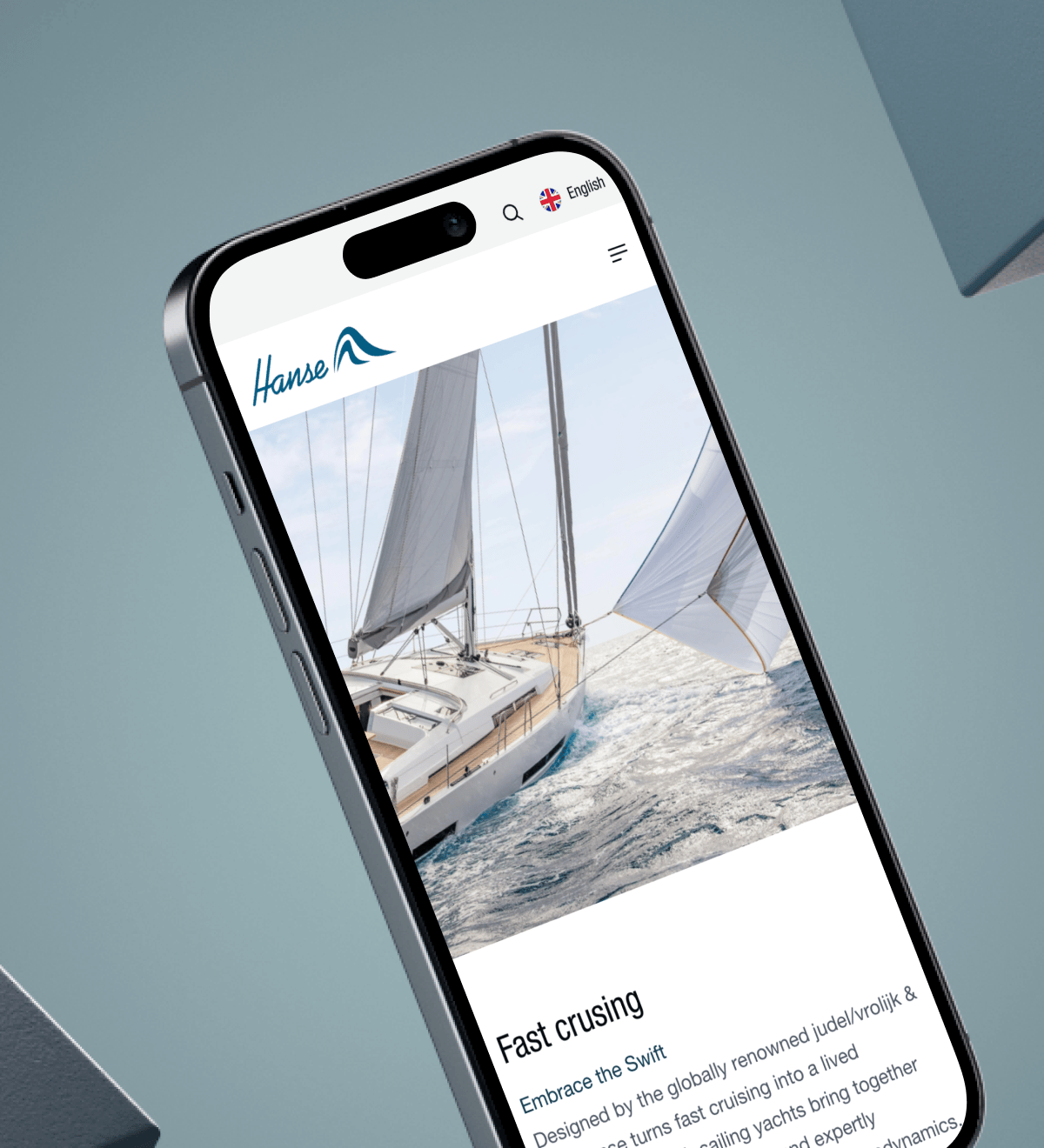

Common questions
Can one platform serve a manufacturer’s multiple brands and markets?
Yes, this is the pattern Bejamas builds most often. For HanseYachts, Bejamas redesigned seven yacht-brand websites on one unified system built with Next.js and Storyblok: each brand keeps a distinct design, while all of them run on one shared component library and CMS. Adding a brand or market becomes a rollout on an existing system rather than a new project.
How does product data from a PIM or ERP get onto the website?
Through APIs, with a clean split between product data and marketing content. The PIM or ERP remains the system of record for specifications, variants, and pricing; the headless CMS owns storytelling and campaign content; the front end composes both on the same page. Bejamas builds that integration layer so product updates flow to the web without anyone re-keying data.
How does Bejamas handle localization for manufacturers selling in many countries?
Localization is modeled in the content architecture from the start: locale-aware content structures, translation workflows in the CMS, and per-market publishing rights. Bejamas rebuilt Van Raam’s site with content managed in English, Dutch, French, and German by their own team, and cut load times from 7 seconds to under 2 in the process.
Do we have to replace our existing systems to modernize the websites?
No. Bejamas replaces the web layer (the CMS and front end) and connects to the systems the organisation actually runs on: ERP, PIM, DAM, CRM, and dealer tooling stay. That is usually the difference between a two-year IT program and a phased web migration that ships its first market in months.